

A positive TB test doesn’t always mean what you think it means. It doesn’t mean you’re contagious, and in most cases, it doesn’t mean you’ll lose a job offer. If you’re facing a TB test for a new position, a few misunderstandings about the test can cause unnecessary worry.
Tuberculosis testing rules have also shifted in recent years. The CDC changed national guidance on how often health care workers need to be retested in 2019. Louisiana updated its own testing rule in 2021 to match. U.S. TB cases climbed for three straight years after the pandemic, reaching a 10-year high in 2023 before dipping slightly in 2025. Here’s what employment TB testing involves, what your results mean and how to walk into your appointment prepared.
Requirements vary a good deal by industry. Health care is the clearest example. Hospitals, nursing homes and other licensed medical facilities screen staff for TB at hire. This is required by both federal and state law. Jobs in corrections, homeless services and other congregate care settings often carry similar expectations. TB spreads more easily where people share close indoor space, so testing is mandated to reduce risk.
Outside health care, TB testing for employment is less common. It usually comes down to company policy rather than a legal mandate. Restaurants, retailers, offices and similar workplaces generally don’t have a TB testing requirement. However, some employers add one voluntarily as part of a broader workplace safety program.
OSHA doesn’t have a TB-specific standard. Instead, it enforces TB protections through its general duty clause. The clause requires employers to keep the workplace free of recognized hazards, along with existing rules on respiratory protection.
Louisiana adds a more specific layer for health care. Under Louisiana’s Sanitary Code, employees, students and volunteers at hospitals, nursing homes and other medical facilities must be tested for TB. Until 2021, the rule also required annual retesting for most of these employees. Louisiana updated that requirement after CDC changed its national guidance in 2019. Now, most health care workers without latent TB infection aren’t required to test annually. High-risk staff may still be tested more often, based on a facility’s own risk assessment.
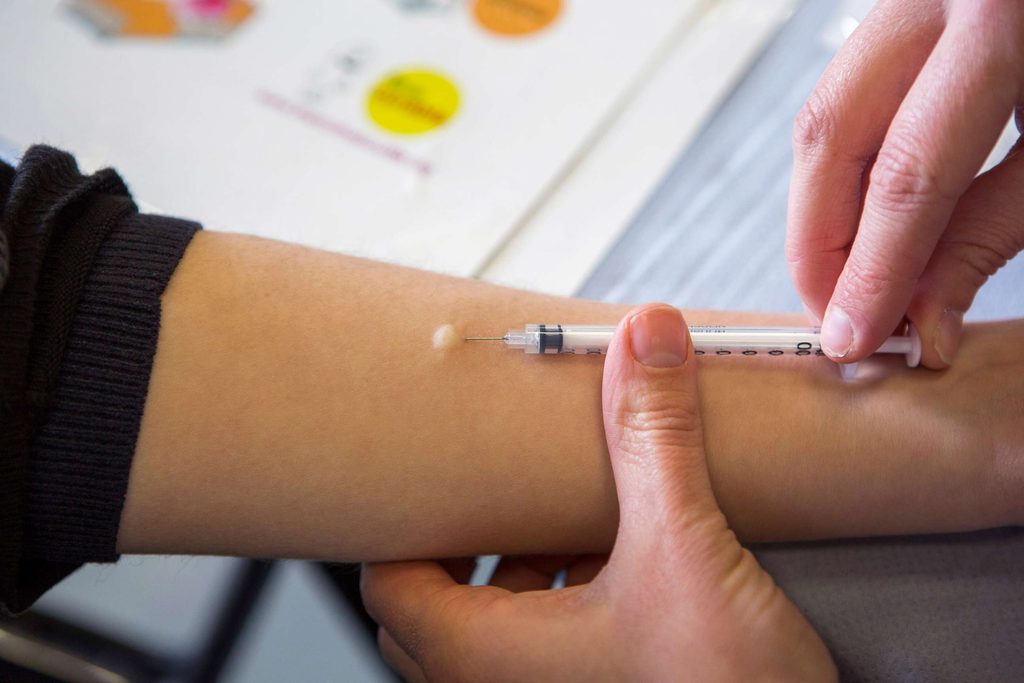
Two tests are used for TB testing. These are the tuberculin skin test, also called the Mantoux test, and the interferon-gamma release assay (IGRA), a blood test. For the skin test, a provider injects a small amount of testing solution under the skin of your forearm. They then read the reaction 48 to 72 hours later.
The IGRA needs only one visit. Your blood is drawn and sent to a lab, which measures how your immune system responds to TB proteins. All Coastal Urgent Care clinics offer both tests and are open seven days a week for your convenience.
Neither test can tell you whether an infection is latent or active. That distinction comes from follow-up evaluation, not the initial test.
Which test you get often depends on your history rather than personal preference. If you received the BCG vaccine, a blood test is preferred since the vaccine can cause false-positive skin test results. The vaccine is common in countries where TB is widespread but not routinely given in the U.S. If you have a weakened immune system or take immune-suppressing medication, your provider may also lean toward the blood test.
For most other applicants, either test is considered acceptable medical practice. Your employer’s policy or your provider’s available equipment often decides. Blood samples must reach a lab within a limited window, so the skin test remains more widely available at smaller clinics.
A negative result generally means you haven’t been exposed to TB bacteria. A positive result means TB bacteria have infected your body at some point, but that’s where the simple story ends. It doesn’t automatically mean you’re sick or contagious.
Most positive results turn out to be latent TB infection. This means the bacteria are present, but your immune system has them contained. You feel fine, and you can’t spread TB to anyone else. Far less often, a positive result leads to a diagnosis of active TB disease. Active disease is when bacteria are multiplying and symptoms like a persistent cough, fever and night sweats are usually present.
A positive test triggers more evaluation, not an automatic diagnosis. Your provider will typically review your symptoms and order a chest X-ray, and sometimes a sputum test. This will help them determine whether you have latent infection or active disease. If it’s latent TB, treatment is about 90% effective at preventing it from ever becoming active disease. A short courses of three to four months is now generally preferred over the older nine-month regimen. If it’s active TB disease, it’s treated with a combination of antibiotics over six to nine months. Most people who complete the full course recover.
The following examples are hypothetical. They are meant to illustrate how TB testing plays out in practice, not accounts of real people or facilities.
Picture a mid-sized Louisiana hospital hiring several new nurses in the same month. Each completes a baseline TB risk assessment and skin test before their first shift. This is required for licensed medical facilities in the state. One nurse’s test reads positive at the 72-hour mark. Because she has no symptoms and a normal chest X-ray, her care team diagnoses latent TB infection, not active disease. She starts a short-course treatment regimen and begins work on schedule, with no restriction on her duties.
Now picture a different scenario at a long-term care facility managing an actual TB exposure event among residents. Because there’s a known exposure, staff there may need testing beyond the usual baseline. This will follow the facility’s exposure protocol rather than routine annual screening. This is the kind of situation for which Louisiana’s 2021 policy update was designed. It reserves repeat testing for when there’s a documented reason for it, rather than requiring it across the board.
A hotel group with locations across southwest Louisiana isn’t required to test housekeeping and front-desk staff for TB. That requirement generally applies only to licensed medical facilities. But after a regional health advisory, the company’s HR team decides to offer voluntary TB testing for new hires. The company’s pays for it, alongside its existing health screenings.
A restaurant group, by contrast, sticks with food-handler permitting and standard health screenings. They skip TB testing altogether, since nothing in its industry or location requires it. Both approaches are reasonable based on applicable state and local rules. The difference is just in how a company chooses to manage its own workplace risks.
The pandemic disrupted routine TB testing and treatment nationwide, and cases have followed an uneven path since. After a sharp drop in 2020, U.S. TB cases rose for three consecutive years, reaching 9,633 cases in 2023, the most since 2013. Cases then edged down slightly in 2025, to 10,260, though they remain above pre-pandemic levels.
TB testing policy has moved toward risk-based testing rather than blanket annual requirements. This shift has happened at both the CDC and Louisiana for most health care personnel. Whether other high-contact industries adopt that approach likely depends on national case count trends in the next few years. For now, the most reliable way to know what applies to your job is to ask your employer. Or, for licensed facilities, check with Louisiana’s TB Control Program.
Bring a photo ID and any paperwork your employer has given you. If you’ve had a TB test before, bring documentation of the result. If it was positive, bring any follow up paperwork, like a chest X-ray report. If you were vaccinated with BCG, mention it, since it affects which test is best for you.
Ask your employer ahead of time whether or not they cover the cost of testing. Also check to see if they accept either test type. Insurance coverage for employment screening varies, so it’s worth a quick call to your insurance company if you’re unsure.
Two myths come up often. The first is that a positive result is common or expected. It isn’t. The CDC estimates roughly 13 million people in the U.S. have latent TB infection. This is a small share of the population, and a positive result is the exception rather than the rule. The second is that a TB diagnosis is a dead end for your job prospects. In reality, both latent infection and active disease are treatable. Most people move forward with their job while completing treatment, particularly for latent infection, which doesn’t require any work restrictions.
Does pre-employment testing still make you anxious? Just try to remember: the test is quick, low-risk and a positive result is a starting point, not a verdict.
Employment TB testing can feel like one more hurdle between you and a new job. But it’s a routine part of hiring in many industries and nothing to worry about. A positive result usually means latent infection, not active disease, and it’s treatable either way. Requirements vary by industry and, in Louisiana, are more specific for licensed health care facilities than for other workplaces. Bring your records, ask your employer what they require and give yourself time for a skin test’s 48-to-72-hour follow-up.
Need TB testing for a new job? Coastal Urgent Care can help. Walk in or book online: https://coastaluc.com/find-a-clinic/.
Most employers rely on an urgent care clinic, occupational health provider or the applicant’s doctor to perform the test. Which test an employer accepts, and who pays for it, varies by company and industry.
Not automatically. A positive result leads to further evaluation to determine whether you have latent TB infection or active TB disease. Typically, this means a symptom review and chest X-ray. Most positive results turn out to be latent infection, which isn’t contagious. That means it generally doesn’t limit your ability to work while being treated. Active TB disease may require a treatment period before returning to certain jobs, particularly in health care.
There’s no blanket federal requirement that employers cover the cost. Practices vary, and some employers, especially in health care, cover testing as part of onboarding. Ask your employer directly before scheduling. Some local employers work directly with our occupational health program to offer TB testing. It may be offered either as a standalone test or as part of a larger pre-employment exam.
Ask your employer which test they require and whether they direct you to a specific provider. If not, options include urgent care clinics, occupational health providers, your primary care doctor and your local health department. At Coastal, walk in or book online: https://coastaluc.com/find-a-clinic/.